Shaker All Over
Mother Ann Lee is ready for her close-up

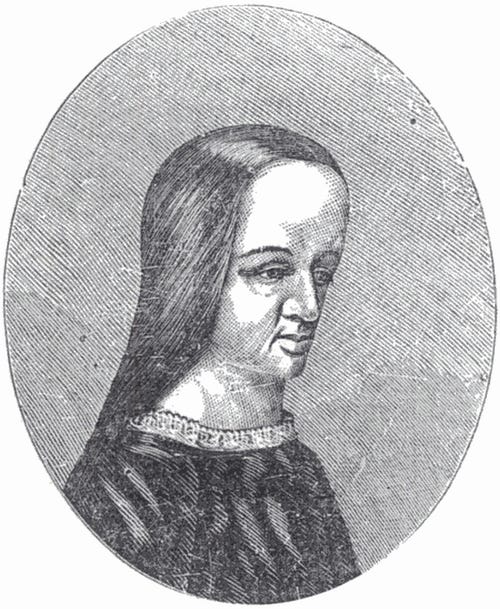
Fess up, now. Can you place the name? Ann Lee, as in The Testament of Ann Lee? Or did you draw a blank when the acclaimed new movie came out?
You’re not alone. Even the film’s with-it Norwegian director Mona Fastvold couldn’t tell Ann Lee from Ang Lee until just a short while back. “How did I not know of this?” she said in an interview last month. “I thought maybe it was just something you learn in school in America. And then I realized that no one knows about her, and maybe her story is thought to be really niche.”
Me, I’m a special case. I’ve known a little something about Ann Lee for many moons now. It’s not because I’m so smart, it’s because Guy Davenport really knows his stuff.
Quick recap. In 1987 the late great polymath prose stylist published a book of essays under the title Every Force Evolves a Form. Arresting turn of phrase, but mighty cryptic. Was it a pilfered scrap of poetry? An inside joke? Something winkled out of some esoteric classical opus?
That would be just like the wily Davenport, but no. Here’s his peach of a gloss in the opening paragraph of his short foreword:
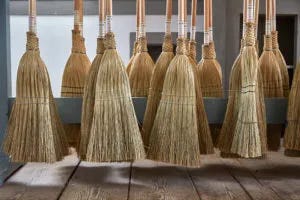
My title, which sounds like Heraclitus or Darwin, is from Mother Ann Lee (1736-1784), founder of the Shakers. In its practical sense, this axiom was the rule by which Shaker architects and designers found perfect forms. The American broom is a Shaker invention: a flat brush of sedge stems, sturdily bound, and with a long handle. Previously the broom, such as Parisian streetcleaners still use, was a fascicle of twigs, which one stoops to use. The Shaker broom sweeps. One’s upright stance in using it has dignity. It is a broom that means business. We are told that Mother Ann, overseeing the high art of sweeping Shaker rooms (the first uncluttered, clear interior domestic space in a century of china-shop impediments), would shout, “There is no dirt in heaven!”
Is it just me, or is that some potent catnip? It’s a graduate seminar packed into a thumbnail sketch. Sounds like Heraclitus or Darwin! A broom that means business! That heretofore unknown Shaker founder named Mother Ann shouting, There is no dirt in heaven!
Consider me hooked. Who knew? Davenport would have nothing more to say about the Shakers or their founder in the eclectic pensées to come – the title essay turns out to be “an unabashedly experimental inclusion … reconstructed from notes on a scrap of paper” on literary allusions to birds – but that scarcely mattered. The title quote planted the seed. This Mother Ann Lee must have been a force of nature unto herself. Down the rabbit-hole I went.
It’s that pithy axiom that really got under my skin. Alliterative, aphoristic, epigrammatic, trips off the tongue. Gnomic, laconic, oracular, akin to a Zen koan.
Davenport nails it – sounds like Heraclitus (the pre-Socratic You-can’t-step-into-the-same-river-twice guy) and also a bit like Darwin (especially the famous closing words of On the Origin of Species that run from so simple a beginning endless forms most beautiful and most wonderful have been, and are being, evolved). An axiom said to serve as a practical rule for finding perfect forms. An axiom that could double as a first principle in philosophy or physics.
As with the axiom, so with its author. So far, so inscrutable. The Shakers had a founder, one founder? Why did they call her Mother Ann? What’s her back story? How to square Davenport’s hermetic title quote with the other line he gives her here, nothing remotely metaphysical but reportedly barked out in a hectoring shout?
It’s complicated. Don’t go looking for the straight dope. Pay no heed to the beloved Shaker hymn that begins ‘Tis the gift to be simple. Mother Ann’s gifts were anything but.
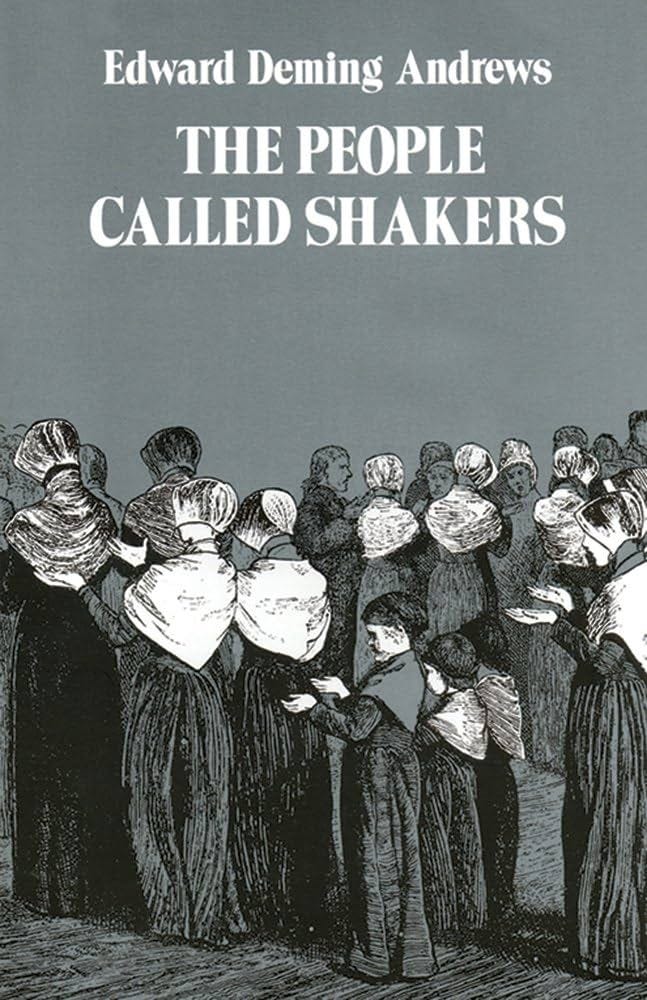
So how much is really known about her? Much more than her ghostly obscurity would suggest. It’s pretty much all there in the pioneering studies of Edward Deming Andrews (1894-1964), to this day the go-to authority on all things Shaker. The self-taught collector-turned-scholar’s cornerstone pair of Dover paperback reprints – The People Called Shakers: A Search for the Perfect Society (1953) and The Gift to Be Simple: Songs, Dances and Rituals of the American Shakers (1962) – will tell you just about everything that can be safely known about the unlikeliest of charismatics who spearheaded it all.
The name’s Lee, Ann Lee. Unbeknownst to most everyone these days, and it’s hard to say why. She’s as far-out a figure as you’ll ever meet in gothic fiction, only freakier.
Born on Leap Year’s Day in 1736 to a Manchester blacksmith, one of eight offspring, her mother’s name unknown. Grew up in the city’s down-and-dirty slum of Toad Lane in the infernal early days of the industrial textile trade. No schooling, no prospects, no end of troubles. A mill girl while still a wee thing, pressed into service as a cutter of velvet and fur. Coerced into marrying her father’s apprentice blacksmith in her mid-twenties, despite making no secret of her primal horror at “the fleshly co-habitation of the sexes.” Gave birth to four children, all lost in infancy or early childhood.
God-fearing from the beginning, only to grow infinitely more so. Fell in with a holy-rolling evangelical sect in her early twenties, the United Society of Believers in Christ’s Second Appearing. A splinter chapter that broke off from the Quaker Society of Friends, seeking to praise the Lord with the utmost devotional fervor. Their ecstatic form of worship – dancing, chanting, raving, tripping out – soon saw them dubbed the “Shaking Quakers.”
They were small in number, but the spirit moved them something fierce. They made no fine distinction between keeping the faith and disturbing the peace. Ann Lee’s white heat blazed their trail. She took to the streets to excoriate the sins of the flesh. She burst into church services and raised a great stink. The local jailers came to know her well.
Prison steeled the blacksmith’s daughter to her calling. Behind bars she had vision after visitation. She made a name for herself. She was now the face and voice of the Shakers. Women weren’t meant to preach the gospel, but the Lord had given her the high sign. She was sent to the clink as a married woman, and came out as the Bride of the Lamb.
So much for her abject old life. She’d made a name for herself, and mere Ann Lee wouldn’t cut it anymore. Released from one lock-up in 1770, she now proclaimed herself Ann the Word. Ann the Word, as in the Word of God. Her followers were to address her as Mother Ann. Mother Ann, as in the mother of them all.
The accusations against her kept coming – witchcraft, heresy, sedition – and so did her revelations. In one dungeon vision, she saw God providing her little band of believers safe passage to the New World, and in 1774 it came to pass. On a hot August day she disembarked at the southern tip of colonial Manhattan Island with a company of eight disciples, including her husband Abraham and her brother William. It had been a seven-week voyage across the Atlantic. It was the soft launch of Shaker life in America.
It all makes for ripping docudrama material, and you have to wonder why it took Hollywood so long to take the tiger by the tail. Hit the house-lights for The Testament of Ann Lee, starring an all-in Amanda Seyfried as the eponymous prophetess. If nothing else, the critical darling of a picture ought to do wonders for Ma Shaker’s name recognition. Beyond that, it’s a mug’s game, and not just because Fasthold has taken an auteur’s liberties with the timeline in her reconstructed scenarios of Shaker material culture. Oscar-worthy as Seyfried’s performance may be, it’s asking too much at this late date to expect any big crack in the cold case of what made Mother Ann tick.
Take the movie’s title. It’s a metaphor through and through. The real Ann Lee left no testament of her own in any sense of the word. Not in the form of a last will and testament, and not as any tangible record of what she believed and wished to be preserved. Not one letter or note, not a jot.
It’s all in the words of others, and it bloody well had to be. She never learned to read or write. The only thing there is in her own hand is her X on the marriage register. Ann the Word was illiterate.
No small detail. It flips the whole Shaker script. She had so much to say. She wrote nothing down. There would be no Shaker gospel without her, but none of it is in her own words. She was Ann the Word, and it was all word of mouth.
Talk about a real throwback. It’s the oldest trick in the book because it’s older than the book. Jesus, the Buddha, Muhammad, all those classical sibyls and oracles and soothsayers, seers and shamans of every stripe – they spoke their words of wisdom and portent, and someone listening in would take it all down and pass it on. As-told-by and as-told-to was the only way to go.
Ancient history, and it marks Mother Ann as a visionary-come-lately. We’re talking old-school prophecy, oracular hearsay like back in the day. The legacy technology of hearsay on the highest authority, hearsay nobody can gainsay. Lend her your ears and pass it on.
Holy moly, wrap your mind around all that. The Shaker mater was the medium of her evangelical message. No writing on the wall, all by word of mouth. All spirit, no letter. Ann the Word did nothing by the book. Her X marks the spot where her radio silence roars.
Except just take a gander at all the words of hers in print. Sayings, apothegms, catchphrases, bywords, counsels, call them what you will. Every force evolves a form. Cool, an axiom for the ages, but what gives? Maybe she said it and maybe she didn’t. Maybe she said it and maybe she only said something faintly like it.
Guy Davenport tells us his title is “from” Mother Ann Lee, then tells us “we are told” she would shout, There is no dirt in heaven! The passive voice tells you all you need to know. What we’re told is all there is to go on. It’s all she said, she said. Hearsay is all there is between her and no there there.


There’s nothing for it but to play it as it lays. It wouldn’t be such a sticking point, except there’s a whole a lot more where that from came from. Hearsay auguries, hearsay pieties, hearsay hellfire, hearsay brimstone. Hearsay visions and revelations. hearsay chapter and verse. All sorts of sayings and saws, a mixed bag of maxims and mantras and mottoes. A bumper crop of Ann the Word’s words to the wise, or so we’re told.
It’s all she said, she said. As the Shakers tell it, she just about said it all. We’re told she was the one who uttered that deathless Shaker precept: Do all your work as though you had a thousand years to live, and as you would if you knew you must die tomorrow. We’re told she coined what has to be the cream of all Shaker creeds, hands-down: Hands to work, hearts to God.
You’ve got to hand it to her. It’s all hearsay, but it’s here to stay. She was Ann the Word, and her word was her bond. She was a one-woman missionary whirlwind, and word got around. She was preaching salvation through a non-negotiable celibate life of communal work and worship. She was foretelling, we’re told, a “Heaven on Earth.” As the American war for independence raged on, she crisscrossed New England to spread the word.
All word of mouth, but what a body of work. All those words of hers in print, and all those devoted Shaker doings she set in motion. When she “passed into the world of spirit” in 1784 at age 48, her charter Shaker settlement in upstate New York near Albany was in full swing, with more on the way. Converts flocked to the growing roster of covenant “Families” to carry on in her name. They were only just beginning to put their stamp on Mother Ann’s promised land.
We’re told it was all foretold. The uncompromising Shaker doctrine, the unshakeable Shaker code of conduct. The unswerving Shaker collective enterprise in word and deed, hands to work and hearts to God. Shaker abstinence and Shaker abandonment in dynamic equilibrium, forswearing carnal knowledge like the plague while at the same time cutting loose in epic orgiastic prayer raves like so many whirling dervishes. Shaker economy, Shaker craftwork, Shaker invention, the austere Shaker aesthetic of perfect forms – the joinery, the cabinetry, the chairs, the boxes, the pegs, the hooks, the first clothes-pins and seed packets, the broom that means business.
All that and more, all foretold by the mother of them all. It all went down just like she said when she said, We are the people who turn the world upside down. The believers took her at her word and set about making good on what they would come to call “Mother Ann’s Work.”
Or so we’re told. What we’re told is all there is to go on. The movie title is an artful figure of speech. The Testament of Ann Lee? There’s no such thing. The prophetess didn’t mince words, but only in a manner of speaking. She can be quoted at length, but there’s nothing from the horse’s mouth.
Nothing doing, no Testament of Mother Ann Lee. Nothing in her own hand but her X on her marriage register. No testament in any shape or form, but wait, here’s the next best thing – a slew of testimonies, all variety of testimonies, testimonies coming out of your ears. An entire bound volume of testimonies, a text set in type at the Shaker sanctum in Hancock, Mass., famed for its jawdropping Round Stone Barn.
Testimonies – that’s the shorthand title right there. Hot off the letterpress in 1816, now rare as hen’s teeth. It’s the ultimate testament to Mother Ann’s millennarian magnetism.The full title says it all and then some: Testimonies of the Life, Character, Revelations and Doctrines of Our Ever Blessed Mother Ann Lee, and the Elders with Her, through whom the Word of Eternal Life was Opened in this Day of Christ’s Second Appearing, Collected from Living Witnesses, in Union with the Church.
A real mouthful, and it’s a tell. As-told-by and as-told-to was always all there was to go on. Some three decades after she left this life, Mother Ann’s earthly mission was still going strong. Ann the Word’s earthshaking way with words, not so much. We’re told the text was assembled at the request of younger Shaker converts, most of whom only knew their Ever Blessed founder as a hallowed maternal name. She had left no testament, so the only option on the table was testimony.
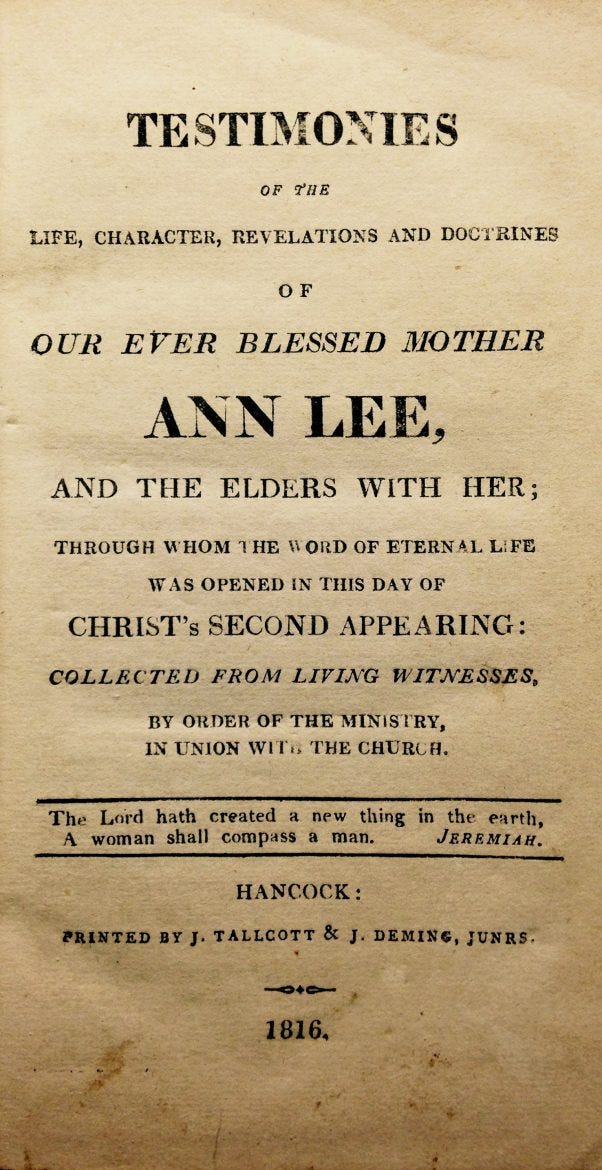
Loads of testimony, testimony from all quarters, all the testimony the traffic would allow. The word on the street, anecdote and scuttlebutt, hearsay on the grapevine, anything anyone could recall hearing her ever saying. Anything and everything she would have put down on paper if only she could, any and all oral history that speaks to Mother Ann’s Life and Character, her Revelations and Doctrines. Every little thing, if memory serves.
As ever, Edward Deming Andrews can be counted on to cut to the chase. He knows from the Testimonies and tells it like it is. In an endnote to quoted passages in The People Called Shakers, he sizes up his source as “Mother Ann’s testimonies regarding her marital troubles, her persecutions and miraculous escapes, her visions, etc. … the testimonies having been ‘collected by living witnesses.’ The book was used solely by the elders and was sometimes called The Secret Book of the Elders.”
There it is in an uncrackable nutshell – an enigma wrapped in an oxymoron. Testimonies recorded long after the fact, testimonies attested by who knows who from who knows when. Mother Ann’s words, all in scare quotes, somehow or another “collected by living witnesses.” Hearsay on top of hearsay. Word of mouth all the way down.
It’s all there in all its muchness, and what a confounding body of work it makes. A doorstop, page after page of Mother Ann’s words, all in scare quotes. A tell-all for posterity, but also a Secret Book. An as-told-to treasury crossed with a game of Telephone. An omnibus of word-for-word transcripts recollected with a little help from the Almighty, the text duly acknowledging that every piece of testimony was bestowed on the witnesses as a remembrance by a special gift of God, after having been, as it were, entirely forgotten, for many years.
All told, you might as well call it a testament after all. Mother Ann in her own words, as it were, complete and unabridged. Entirely forgotten, but now set down verbatim. Neatly packaged in fortysome chapters to shepherd you through all of Mother’s categorically imperative counsels to the faithful.
All her precepts and homilies, all her admonitions and exhortations, all her articles of faith and pearls of wisdom. The gospel according to Mother Ann in all her glory, from God’s lips to her ears. The story of her lost-and-found life in unsparing detail, her trials and torments, her visions and raptures, her deliverance from the clutches of conjugal relations in body and soul. Everything you ever wanted to know about the prime mover of the people who turn the world upside down.
Everything meaning virtually anything. Every steadfast Shaker scruple someone said she said all should observe. Every devout Shaker dictum someone said she must have said first, every blessed thing we’re told could only have come out of her mouth.
From what we’re told, it sounds like words never failed her. We’re told one time she announced to everyone within earshot that a flurry of dust motes in a sunbeam were specks of angels’ wings. We’re told one time a young convert asked what to do with family baubles like gold beads and silver buckles and she answered, You may let the moles and bats have them.
We’re told she once described a fever dream that told her how right she always was to say lust is the root of all damnation: I saw a large black cloud arising … and it was occasioned by men’s sleeping with their wives.… Their torment appears like melted lead, poured through them in the same parts where they have taken their carnal pleasure.
We’re told that fresh off the boat in on that summer’s day 1774, she marched her ragtag flock up Broadway all the way to a certain residence on a side street with a family sitting on the front steps, striding right up to them and saying: I am commissioned of God to preach the everlasting Gospel to America, and an Angel commanded me to come to this house, and to make a home for me and my people.
We’re told the mistress of the house took them in on the spot.
So we’re told and so it goes. It’s a biographer’s nightmare and a screenwriter’s dream. It’s got big-screen bio-pic written all over it. You can give Mother Ann all the best Shaker lines with bells on, since that’s what the Shaker elders do in their own credits anyway.
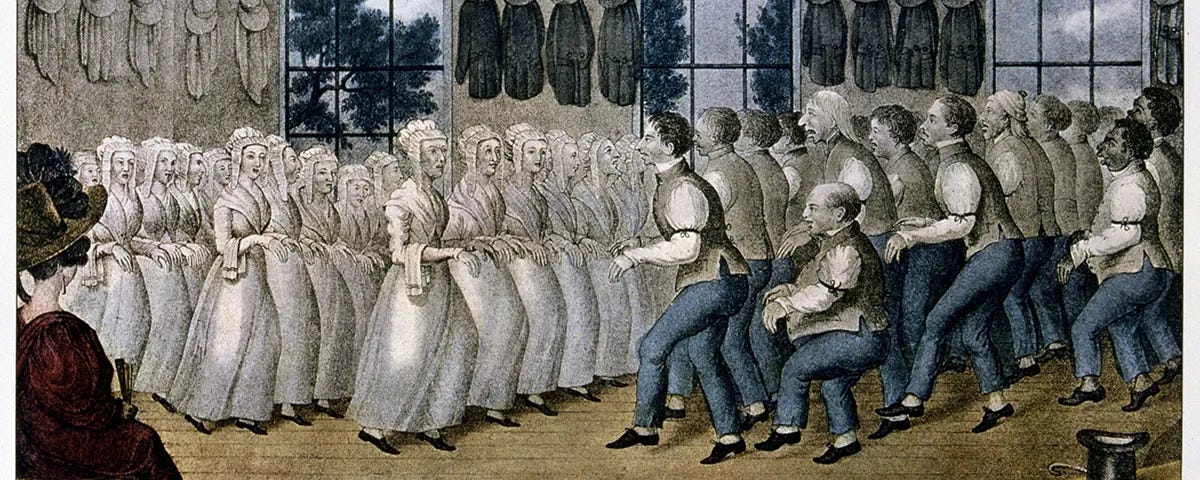
Even so, it was a shrewd move for Fastvold to script The Testament of Ann Lee as a whambang movie musical. All the better to channel the pulsating historical spectacle of delirious Shaker song and dance. All the better to reenact the shake, rattle, and roll of the roof-raising Shaker sabbath at peak fever-pitch, by all contemporary reports a righteous bedlam to behold.
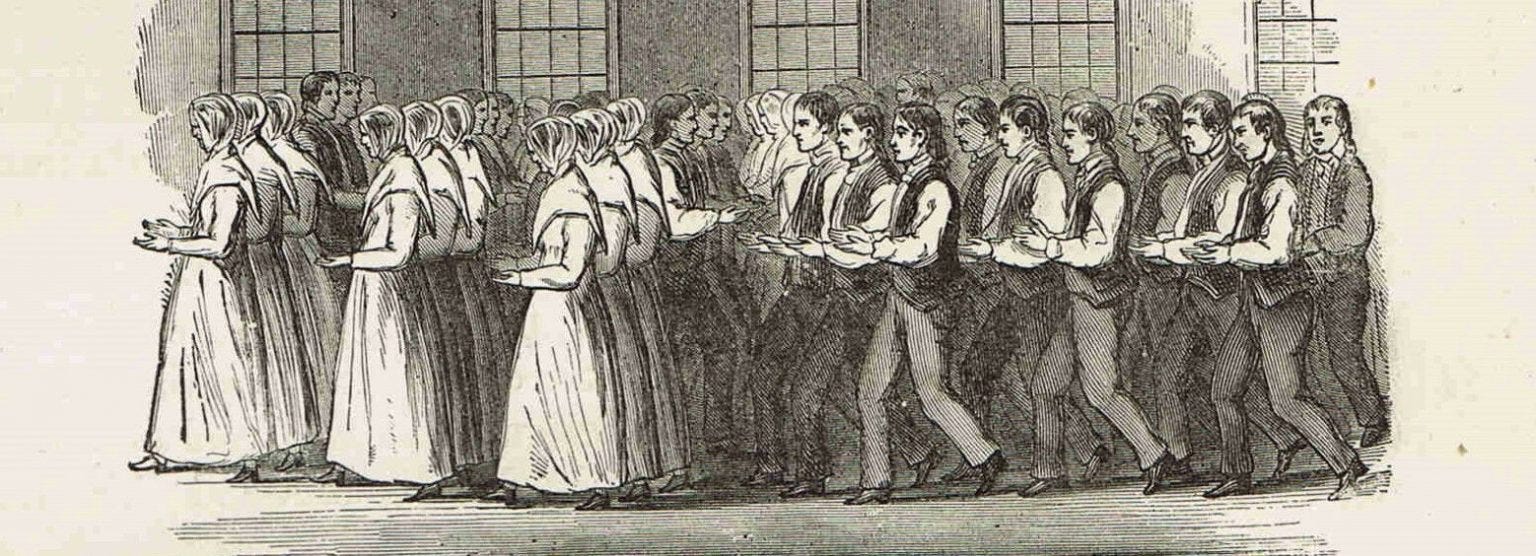
Not that there’s any giving Mother Ann the slip out on the meeting-house dance-floor. She’s the presiding spirit who runs the show and doesn’t miss a beat. Her numinous fingerprints are all over the first Shaker hymnal, Millennial Praises (1812), with many a ditty singing her praises by name.
As Andrews explains in his annotated edition The Gift to be Simple, the Shaker custom of breaking into spontaneous song in the midst of sabbath prayers was held to be Mother Ann Herself beaming in from the beyond, making her presence felt in the possessed voices of “Mother’s little children” and “Mother’s little lambs.”
It’s enough to make you wonder if the Shaker hymn-book as we know it is begging to be rebranded as Mother Ann’s Greatest Hits. Andrews notes that the trance spirituals loosely known as “vision songs” were often “cherished as sacred messages or gifts” from Mother Ann’s “ethereal lips,” the lyrics commonly amounting to a single running refrain along the lines of Moth-er says go on dear child-ren, Moth-er says re-joice re-joice!
There’s even a number called “Mother Ann’s Song,” with a lyric sheet faithfully reprising her fabled penchant for speaking in tongues. You can tell from the opening bars that glossolalia must have really been her jam: Vum vi-ve vum vi-ve Vum vum vo.
Sing it, sister. It’s your special gift. It’s your messianic M. O. You’re still the last word on the bygone Shakersphere even when you’re talking nonsense. “Note that Mother Ann herself did not sing this song,” Andrews comments, “but that it was received from her spirit.”
Noted. Message received. Sometimes it feels like we should be calling her Mofo Ann, badass to the bone. She had no letters, but her way with words must have been her superpower. She said it all, or so the Testimonials tell us. It’s all hearsay, but it’s here to stay. I didn’t say all the things I said, Yogi Berra once said, but Mother Ann is in a league of her own.
So did someone somewhere ever overhear her say Every force evolves a form? No telling, but by all rights it should be her epitaph. From all we’re told, she was the primal force behind it all. Every form of Shaker devotion and expression from A to Z. All those Millennial Praises and Millennial Laws. All those simple gifts that kept on giving. All those perfect forms, Hands to work and hearts to God.
It couldn’t last – see under Celibacy – but it had a good long run and the Shaker creed of form at one with function in spiritual and material life still runs deep in the American grain. It’s all a living testament to the one-woman mystical force-field that was Mother Ann, the mother of it all by word of mouth. She didn’t say all the things she said, but let’s just say she said it all anyway. She couldn’t read or write, but she was Ann the Word. She told us so, or so we’re told.