Murders & Murmurations
The Poetry of Venery

I. Dame Juliana, Her Boke
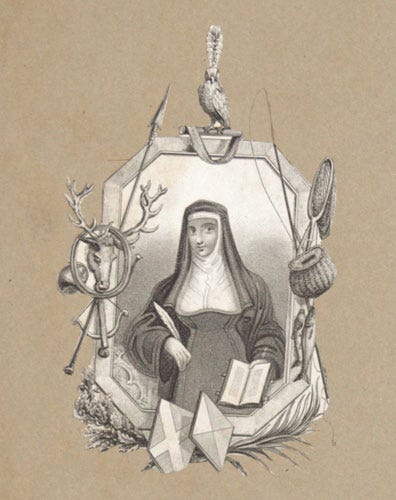
She’s still sometimes hailed as the earliest English poetess. Yes, poetess, as in prioress, which she evidently was as well. Or so the story goes. The hard evidence is spotty, the lacunae many. Learned conjecture says this, informed speculation says that. It was forever and a day ago. If she was who she was she was really something, a true badass. Or so the story goes.
Her name in various spellings is pretty much all there is for sure to go on. There it is in the colophon of the Boke of St. Albans, dated 1486: Explicit Dame Julyans Barnes in her boke on huntyn. There it is again in the celebrated 1496 edition of the Boke by Wynkyn de Worde: Explicit Dame Julyans Bernes doctyne in her boke on huntyn. Explicit the printer’s shorthand for explicitus est (“it is unrolled,” “here ends”), making the book’s author explicit. Standardize the spelling and there you have it: The Book of St. Albans, the book of Dame Juliana Berners, her book on hunting.
Here ends her book, and then the wrangling begins. Did Dame Juliana write the thing, or just compile it? Did she write some of it and swipe the rest? Can it be safely assumed that she was the woman of learning and breeding the world knew as Lady Julian Berners, the Prioress of the Nunnery of Sopwell outside the abbey town of St. Albans – the daughter or grand-daughter of Sir James Berners, a favorite at the court of Richard II until his beheading in 1388? Or could she have been a Dame in name only? How did she come to be someone with her name on a volume printed under the full title Boke of hawkynge huntynge and fyschynge with all the propertyes and medecynes that are necessarye to be kepte?
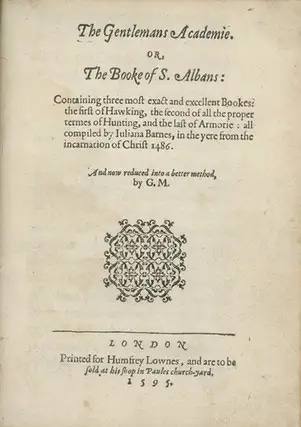
Learned conjecture says this, informed speculation says that. What can be said without dispute is that the book with her name on it was a big hit and a gamechanger. Surviving records show it went through numerous printings in its day and far beyond, largely due to the wild popularity of the bonus section lumped into the 1496 edition printed in Westminster, the Treatyse of Fysshynge wyth an Angle. All the work of Dame Juliana so far as it was ever acknowledged, even as she remained a mystery wrapped up in an enigma. It was her Boke, and the book made her name.
II. Listen to Your Dame!
So what sort of book was it? In modern parlance an instruction manual, an authoritative guide to the so-called “field sports” of the English woodlands and wetlands. Hawking, Hunting, and Fishing, in that order, hands-on lessons on how to hawk and hunt and fish off the countryside with requisite skill and all due propriety.
Considerable propriety was due indeed, squarely placing the work in its proper period genre as a medieval “courtesy book” for young gentlemen of nobility. Dame Juliana’s book is above all else a tutorial on decorum – everything a stripling of high station should know about how to comport himself with his hawks and his hounds in pursuit of stag, boar, or hare. Pro tips take a back seat to courtly precepts. The sport was a rite. The hunt was an art.
The hunt was an art and it went by the name of venery. From the Old French venerie, out of the Latin venari, to hunt. Ergo, Dame Juliana’s how-to book for novice noble huntsmen understood to be a special type of courtesy book known as a book of venery, plainly modelled after an earlier treatise from the court of King Edward II, Guillaume Twici’s Le Art de Venerie. The art of venery, meaning the art of hunting in keeping with the scripted codes of knightly honor, observing every nicety befitting a blueblood’s bloodsport. The hunt was an art that went by the name of venery, and the beasts of venery were the noble beasts only noblemen could hunt.
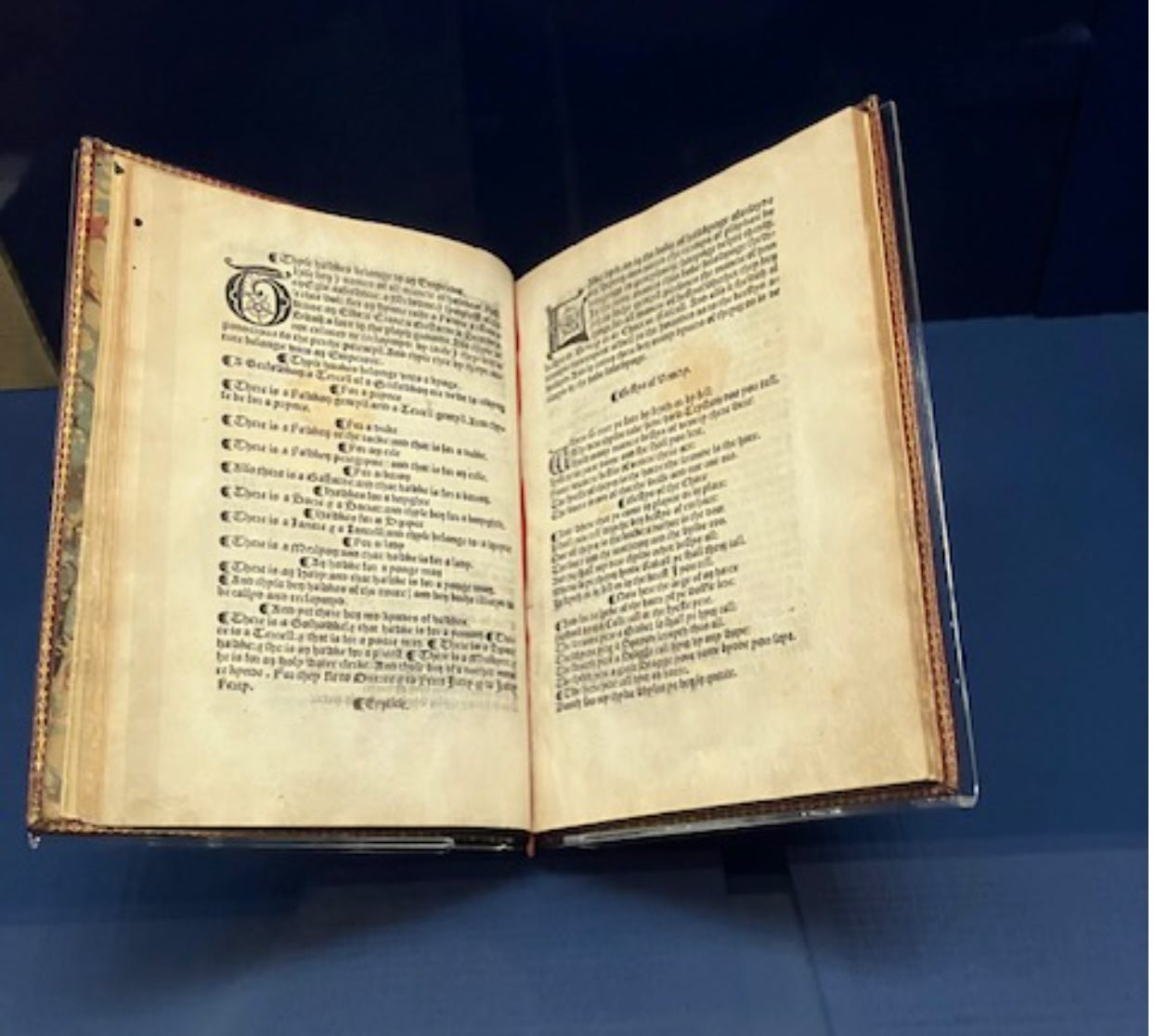
The term of art appears right at the top of the Book of Hunting, the one and only part of Dame Juliana’s book written entirely in verse. It’s the title of the first of a raft of short poems that go over the basics in brisk rhyming couplets:
Bestẏs of venerẏ
Wheresoere ye fare by fryth or by fell
My dere chylde take heed how Trystam you tell.
How many maner beestys of venery ther were
Lystyn to yowre dame and she shall yow lere
Fowre maner beestys of venery there are
The first of theym is the hert, the secunde is the hare
The boore is oon of tho, the wolff and not oon moo
Listen to your Dame! She’s here to bring you up to speed on the four beasts of venery, as decreed by the sovereign Anglo-Norman ordinances over who could hunt what in the royal forests. That would be the hart, the hare, the boar, the wolf, and not one more, my dear child. Heed the word of Sir Tristram of Arthurian fame, the shining paragon of the chivalric huntsman who legend has it first spelled out all these terms of art. They’re not to be trifled with, lest you fall from grace and can’t get up. Your Dame knows what’s what, dear child, and she’s written it out in verse so you can get it by heart.
So far, so plausible. Possibly it’s a put-on for literary effect, but scholarly consensus holds that if Dame Juliana’s fingerprints are anywhere on the text, it’s got to be here in the lively running stanzas on minding your manners out on courtly hunting parties. After the Beasts of Venery come the Beasts of the Chase (the Bucke, the Doo, the Fox and the Martron, and the wilde Roo), and then the real action begins – an extended series of verses discoursing on the nitty-gritty of bagging various types of game in ample tactical and technical detail.
They all fall under their own red-marked headings, and what headturning headings they are. Here’s Of the huntẏng of the haare, dear child, and here’s Of the hornẏs of a Bucke. Turn the page, here’s Wiche beestes shall be flaẏne & wich stripte. Read on to learn how to mark well each one’s Hunting Season, how to butcher a deer and dress a boar. Don’t miss the verses that will verse you in the Cries of the Hart and the Hind, and which Parts of the Hare To Reward the Hounds With.
Listen to your Dame and you shall learn. She’s the maternal voice of authority and she doesn’t miss a trick. Sometimes she addresses you as “my chylde” and sometimes as “my sonnys.” Sometimes she shifts into a verse dialogue between a fledgling charge and his master huntsman. You get the idea – this book’s for you, young buck, here’s your primer on courtesy and venery under one cover, your training manual on the skill-set and the etiquette you’ll need under your belt before you can call yourself a man of the hunt. You may be to the manner born but you still need to be drilled in the right stuff. That’s why there’s a lengthy third book here in color cataloguing all the heraldic coats-of-arms, so that you shall know “how gentilmen shall be knowyn from ungentill men.”
Dame Juliana wraps up her rhyming tutorial with a meaty practicum on how to field-dress a deer (How ẏe shall breeke an Hert), showing real chops in sparing her sonnys no gory details. Here’s the printer’s Explicit, here ends her boke of huntyng. But wait, there’s more.
It seems to be a miscellany, mostly an assortment of lists along with a few proverbial sayings, a grab-bag of odds and ends with no particular relation to the topic at hand other than a savvy conversancy with all manner of beasts. Not much verse to speak of, but at least one little something that’s still a doozy of a poem to this day. For more than a few of us poet-types, it must have been our first brush with the ghostly name of one Dame Juliana Berners:
A greyhound should be headed like a Snake,
And necked like a Drake,
Footed like a Cat,
Tailed like a Rat,
Sided like a Team,
Chined like a Beam.
The first year he must learn to feed,
The second year to field him lead,
The third year he is fellow-like,
The fourth year there is none sike,
The fifth year he is good enough,
The sixth year he shall hold the plough,
The seventh year he will avail
Great bitches for to assail,
The eighth year lick ladle,
The ninth year cart saddle,
And when he is comen to that year
Have him to the tanner,
For the best hound that ever bitch had
At nine year he is full bad.
That’s “The Properties of a Good Greyhound” as it appears on page 352 of The Rattle Bag, the 1982 poetry anthology so beguilingly assembled by Ted Hughes and Seamus Heaney, the poems organized not chronologically or by author but alphabetically by title. “What we were after,” Heaney reflected two decades later in his essay “Bags of Enlightenment,” was “some combination of rareness, seriousness, and unexpectedness,” and the Dame’s good greyhound delivers on all counts all by itself. The opening skein of similes reads like an Anglo-Saxon riddle out of the Exeter Book, the familiar breed shapeshifting into some fabulous chimera in short order before the countdown couplets in dog-years take over and things get down to business. It’s a rare mix of adept prosodic wherewithal and shrewd folk wisdom, and its innate unexpectedness remains undiminished six centuries on.
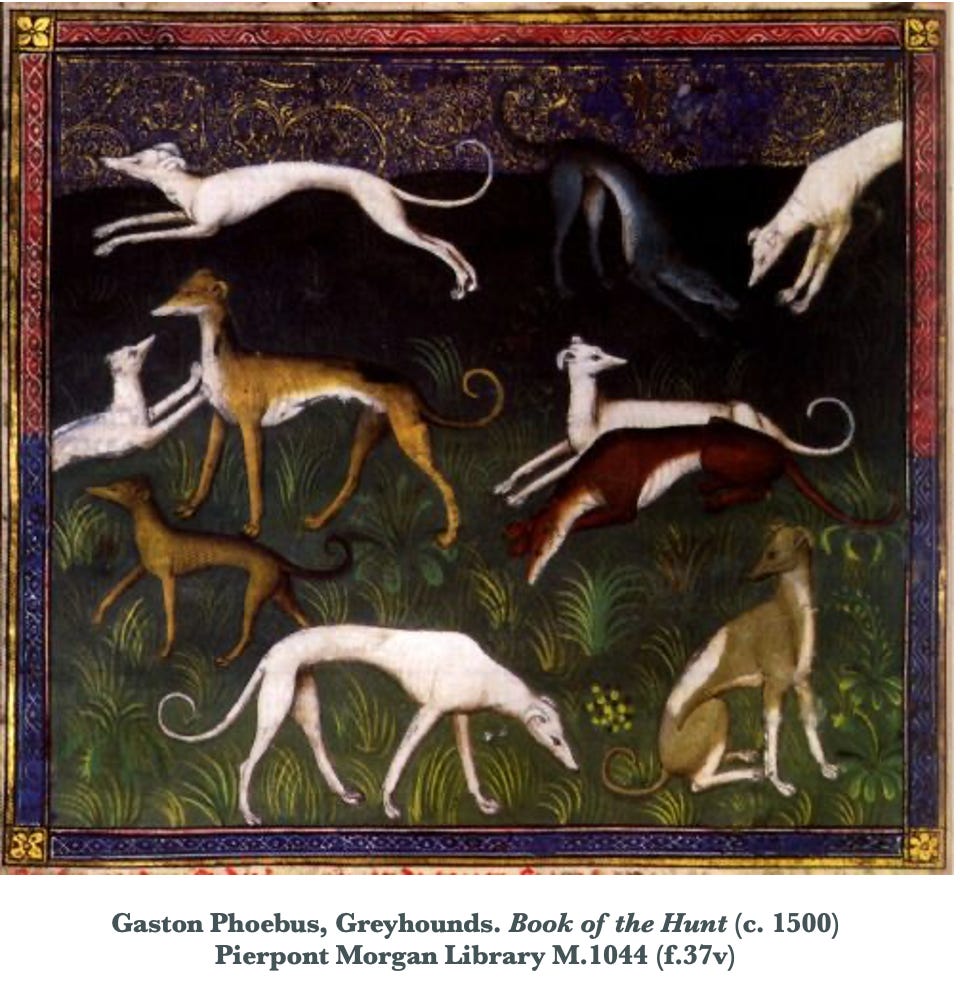
It’s scarcely less unexpected in its original setting too. Why isn’t The propreteis of a goode Grehound part of the Boke of huntyng proper, pray tell? It feels like it belongs up there with the Dame’s other verses on the caring and training of your houndes. It seems too choice a piece of her mind to simply be padding for the printer to fill out blank leaves, which is what some speculate accounts for these jumbled extra bits. The same goes for the next item, The propretees of a goode hors, a likeminded poem that offers a wry brief for the ideal equine as the sum of all the best qualities of a man, a woman, a fox, a hare, and an ass. Kind of a gag, it would seem, all amusement and no instruction. Are you still listening to your Dame here, or some sort of bootleg rendition?
Impossible to say at this late date, but it’s hard to stop worrying at it. It can start to feel like a little milestone in English literary history is on the line. The technical expertise on display in the Boke of huntyng might have been largely poached from benchmark French sources (as medievalists often allege), but the poetic aplomb in the mix has to stand on its own merits. Every plucky couplet and nifty conceit counts. If the Dame’s going to live up to her future repute as the first English poetess by name, she’d best not have any holes in her portfolio.
To be continued…
Next up:
III. The Companies of Beasts & Fowls
IV. Herd Mentality